
At 10:14 AM, the line monitor flashes red: CNC-04 spindle temperature has hit 84.6 °C, crossing its 80.0 °C safety limit.
For most digitized plants, routing that sensor spike to a wallboard or chat channel is already solved. What drains operational teams is what happens in the hours after the alarm rings.
A dispatch supervisor typically grinds through five manual steps in sequence:
- Open MES: look up which work order is active on
CNC-04(WO-2048), remaining operations, and completion percentage; - Switch to ERP: trace
WO-2048to customer orderSO-9031, promised delivery (tomorrow 10:00), and whether late shipment triggers a penalty clause; - Check peer capacity: scan similar machines in the shop—
CNC-06looks idle, but someone still has to verify fixture changeover time and whether another rush order has it booked for the afternoon; - Call maintenance and assembly: check
CNC-04repair history in EAM or phone the maintenance lead—is it a coolant blockage or bearing wear? If we throttle speed to 70% to finish the batch, do we risk dimensional scrap? How many hours of buffer does Assembly Line 2 have left? - Decide and re-key: once the trade-off is settled, manually reassign the job in MES, open a repair ticket in EAM, and message assembly and sales in chat with the revised ETA.
Across that entire episode, the actual human judgment takes maybe five minutes. The rest goes to copying IDs across four tabs, assembling context by hand, and re-entering updates—all under pressure where missing one hidden constraint (like a 2:00 PM maintenance window on CNC-06) sets off a second wave of delays.
Why Fully Autonomous Write-Back Fails on the Shop Floor
An obvious engineering instinct follows: if the steps are repeatable, why not build an autonomous agent that calls the MES API and reroutes the work order the instant temperature crosses 80 °C?
In live manufacturing, hands-off write-back rarely survives its first month:
- Critical constraints live outside the database:
CNC-06may read as idle in MES, yet the shop manager just reserved it verbally for an aerospace part after precision laser calibration; - Trade-offs rarely have one mathematical optimum: rerouting to
CNC-06protects delivery at the cost of a 25-minute changeover; throttlingCNC-04to 70% avoids changeover but adds a 4.2-hour slip that blows past Assembly Line 2's 2-hour buffer. Balancing delivery, cost, and machine life requires an accountable human owner; - Post-mortems require evidence: if a background script silently alters a schedule and ruins a batch, quality and operations leaders need to see the exact state observed at decision time, why that option was chosen, and who signed off.
What actually works in production is neither passive alerting nor black-box autonomy—it is automated context assembly, side-by-side option comparison, and governed execution after a named owner approves.
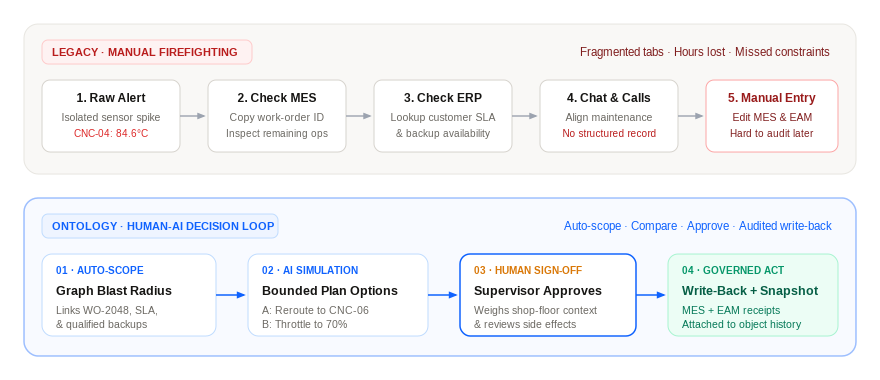
Figure 1: Manual cross-system firefighting versus an ontology-driven human-AI decision loop.
Three Deterministic Stages for Exception Handling
In Yogu Compass, that same CNC-04 overheat event flows into one structured, three-stage loop:
Stage 1: Automatic Blast-Radius Scoping Along the Ontology
Instead of forwarding a bare 84.6 °C text alert, the platform traverses the ontology graph immediately:
Equipment(CNC-04, 84.6°C, +4.6°C over limit)
  └─ runs ──▶ WorkOrder(WO-2048, 3.5h remaining, 5-axis precision milling)
                ├─ feeds ────▶ AssemblyLine(Line 2, current buffer 2.0h)
                └─ fulfills ─▶ SalesOrder(SO-9031, Tier-1 Account, due tomorrow 10:00)
In parallel, the engine filters peer equipment in the same plant by process capability, live status, and upcoming 8-hour schedule—surfacing qualified backups such as CNC-06 (idle, 5-axis capable, 25 min changeover). The first screen the supervisor sees already holds the full operational picture.
Stage 2: Bounded Option Comparison with Explicit Side Effects
Working from the frozen object snapshot and process rules, the AI assistant presents structured options side by side—making projected impact and exact downstream writes transparent before anyone clicks approve:
| Evaluation Criterion | Plan A: Reroute to CNC-06 (Recommended) | Plan B: Throttle CNC-04 to 70% Speed |
|---|---|---|
| Projected delivery slip | 0 h (on-time tomorrow 10:00) | +4.2 h (misses customer commitment) |
| Assembly Line 2 impact | None (within 2.0 h buffer) | Forces a 2.2 h assembly shift |
| Trade-off / risk | 25 min fixture changeover cost | Sustained heat risks tolerance drift or breakdown |
| Downstream actions | MES reassign job + EAM open ticket | MES cap spindle speed + ERP update ETA |
The supervisor can interrogate edge cases right on the card ("does CNC-06 have afternoon maintenance? what if changeover runs 15 minutes over?") or tweak parameters to re-simulate. The model computes inside explicit rules; the supervisor owns the call.
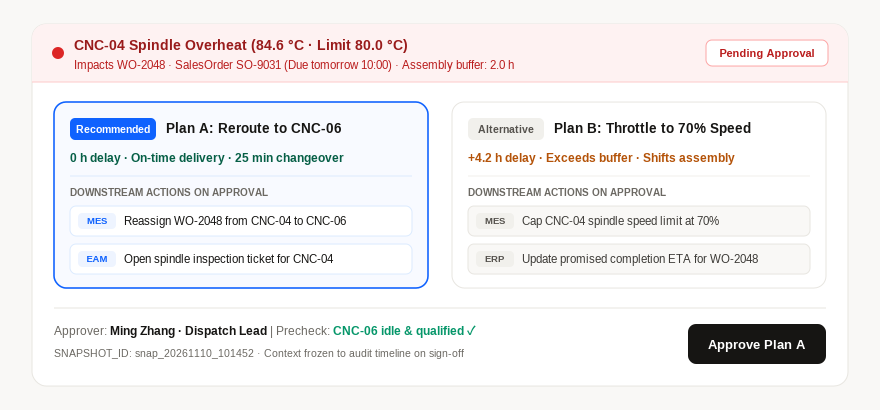
Figure 2: A human-AI decision card unifying blast radius, bounded plan comparison, downstream side effects, and sign-off.
Stage 3: Approval as Governed Execution with a Frozen Snapshot
Once the supervisor verifies no verbal reservation on CNC-06 and clicks Approve Plan A, the action engine invokes the predefined MES and EAM connectors in order and displays each external receipt directly on the card.
Just as importantly, the platform writes an immutable decision snapshot onto the object timelines of WO-2048, CNC-04, and SO-9031:
- The exact telemetry curve, backup machine availability, and order deadlines observed at sign-off;
- The comparison data between accepted Plan A and rejected Plan B;
- Approver identity, timestamp, operator notes, and every downstream API receipt.
Preventing Approval Fatigue: How to Keep Sign-Off Meaningful
Operations leaders rightly ask: if a supervisor receives 50 recommendation cards a day, won't approval decay into rubber-stamping "Approve" without reading?
Three guardrails prevent that failure mode:
- Tiered routing by blast radius: low-risk, reversible actions below defined thresholds (such as sending early warnings or drafting a maintenance ticket) run automatically without waking a human. Only schedule mutations, cross-warehouse transfers, or Tier-1 SLA impacts enter the approval queue.
- Surface uncertainty prominently: cards highlight not just why a plan is recommended, but also any unverified constraints or stale fields (e.g., data synced more than 5 minutes ago) so reviewers know exactly where to focus.
- Weekly feedback loops into preconditions: reviewing proposals that humans rejected or modified reveals undocumented shop-floor constraints, which teams encode directly back into ontology preconditions.
Closing Thought
Historically, a plant's best exception-handling instincts lived in phone calls, chat threads, and individual memory—evaporating whenever shifts rotated.
Running blast-radius scoping, bounded option comparison, and governed write-back on one ontology turns recurring firefighting into reusable action templates and auditable institutional memory. For frontline teams, the payoff is tangible: less time shuttling order IDs between four tabs, more time making the judgment calls that actually require a human.